
Duval County Released Mugshot Records
A booking photograph is created during an arrest and booking process. It stays tied to that custody episode after release, but the image does not establish the outcome of the criminal case. The jail's Released date answers when JSO custody ended. The Duval court docket may later show dismissal, plea, adjudication, sentence, or another disposition. These facts must not be collapsed into what a photograph seems to show.
Florida's Public Records Act supports access to nonexempt state and local records, including many arrest and booking materials. Access is not absolute. Sealing, expunction, juvenile confidentiality, active-investigation concerns, and other statutory exemptions can limit what a custodian releases or displays. An online omission is not proof that no photo was taken, and a visible image is not proof that the person remains in jail.
JSO's public overview says mugshots and charges can be viewed in its inmate search. The current deployed detail interface did not visibly guarantee a photograph on every record during the research review. The accurate approach is to check the exact historical booking, then use the Public Records Unit when the image is missing.
Where Duval Released Mugshots Appear
Choose the source that created or lawfully holds the image. A Duval jail photograph and an FDC offender photograph may depict the same person at different times. They are not interchangeable records. VINELink may help identify a custody record, but the research did not verify it as the authoritative booking-photo archive for JSO.
| Channel | Has a photo? | How to access it |
|---|---|---|
| JSO historical inmate search | JSO describes mugshots as viewable, but a photo may not display on every current record or interface. | Clear the active-only checkbox, match the booking, and open its detail. |
| JSO Public Records Unit | May provide a nonexempt booking photograph tied to a specific Arrest & Booking record. | Submit a focused request with name, JSO ID or Jail Number, and booking date. |
| FDC offender detail | Commonly displays an FDC photograph. | Use the state record only when the person has an FDC custody or release history. |
| Official news or social post | Sometimes, for a selected event. | Match the image to the official booking identifiers and current case record. |
| Local news archive | Sometimes, depending on editorial coverage. | Treat it as a historical publication, not a complete release source. |
| Third-party archive | May retain copied images. | Use only as a lead and confirm identity and status through official records. |
A same-name image can create a serious identity error. Compare the Jail Number, JSO ID, booking date, age or birth data where lawfully displayed, charges, and court case number. The Duval County released-inmate record path helps classify the custody episode before any image is attributed to a person.
The official JSO inmate-information page documents its claimed historical and mugshot coverage.
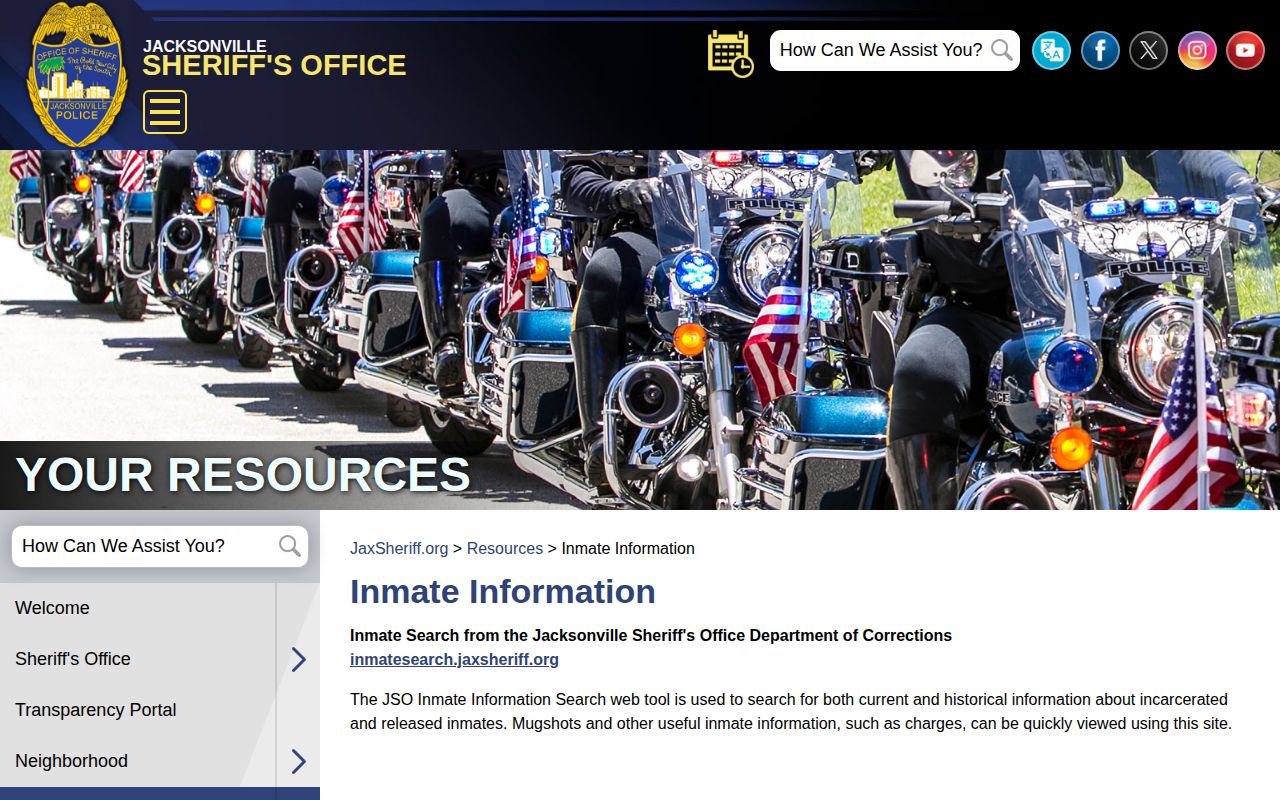
That statement supports checking JSO first, while the live booking and records custodian control actual availability.
Duval Sheriff Mugshot Search Limits
JSO's name search includes a checkbox labeled Search Only Inmates in Jail. Clear it to include historical and released results. The result display can show a custody status of Released with a date, while the detail carries identifiers and booking facts. This is the proper online starting point for a released Duval booking photo because a current-custody-only query may hide the relevant episode.
No current official JSO inmate mobile app was verified. Old references to an earlier app do not establish a working 2026 booking-photo source. JSO promotes its official social accounts, but those posts cover selected events and do not function as a complete photo or release archive. Do not install an unverified app or treat a social post as proof of current status.
The captured JSO Search by Name form shows the active-only control used to reach released records.
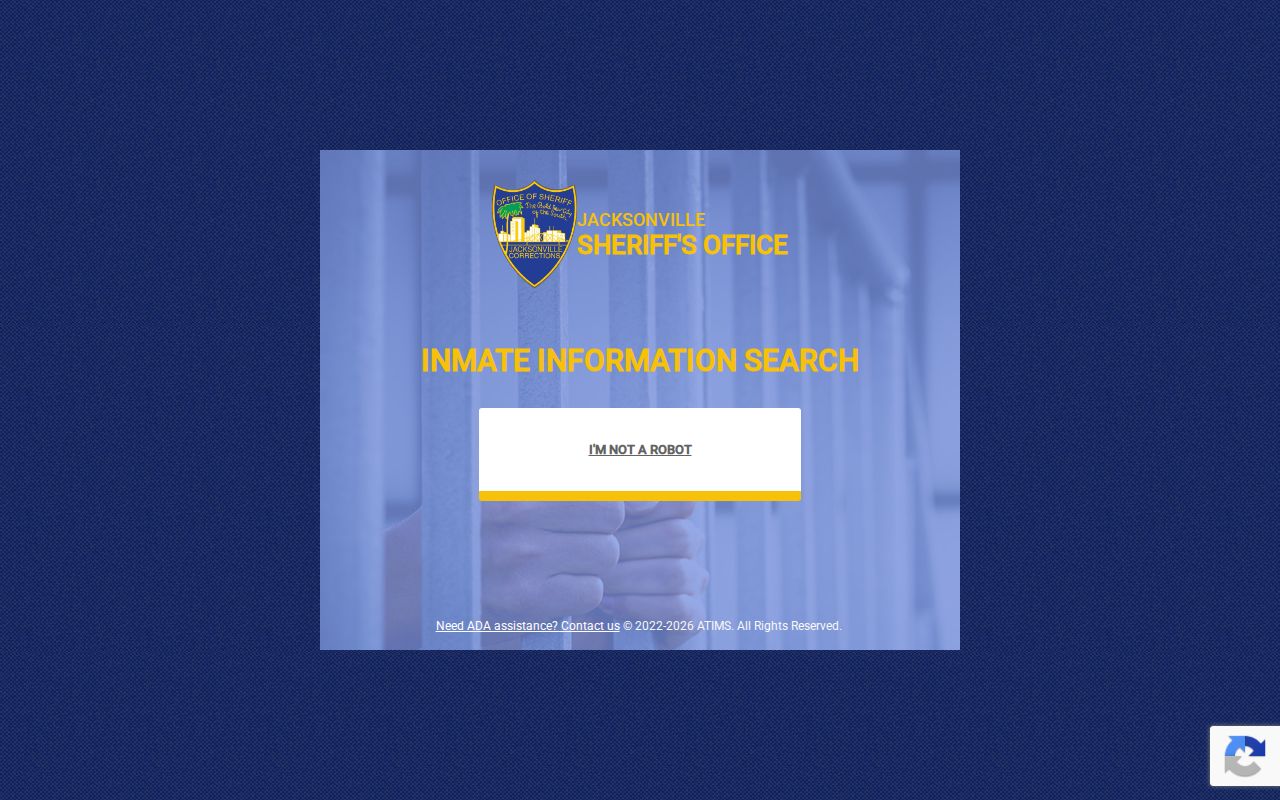
Clearing that box changes the search scope, but it does not guarantee that every historical image remains visible.
Request Duval Released Booking Photos
The JSO Public Records Unit is the authoritative fallback when an online booking does not show a photograph. A narrow request should identify one custody episode and ask for the booking photograph as part of the Arrest & Booking record. JSO accepts requests online, by phone, by mail, and in person. It does not publish a fixed booking-photo price or guaranteed response time on the relevant page.
- Collect the full name, Jail Number or JSO ID, and booking or admission date. Add the case number when known.
- Open the JSO Public Records page or call the unit at 904-630-2209.
- Ask for the booking photograph tied to the specified Arrest & Booking record. Request the nonexempt remainder if part is withheld.
- Choose electronic delivery when practical and ask for a cost estimate before fees exceed a stated amount.
- Compare the returned identifiers with the release record before treating the image as a match.
Requests by mail go to Jacksonville Sheriff's Office, Attn: Public Records Unit, 501 E. Bay Street, Jacksonville, FL 32202. Florida law allows authorized copy charges and a special service charge for extensive labor or technology use. A focused request reduces both identity risk and unnecessary review.
The official request page is shown below.
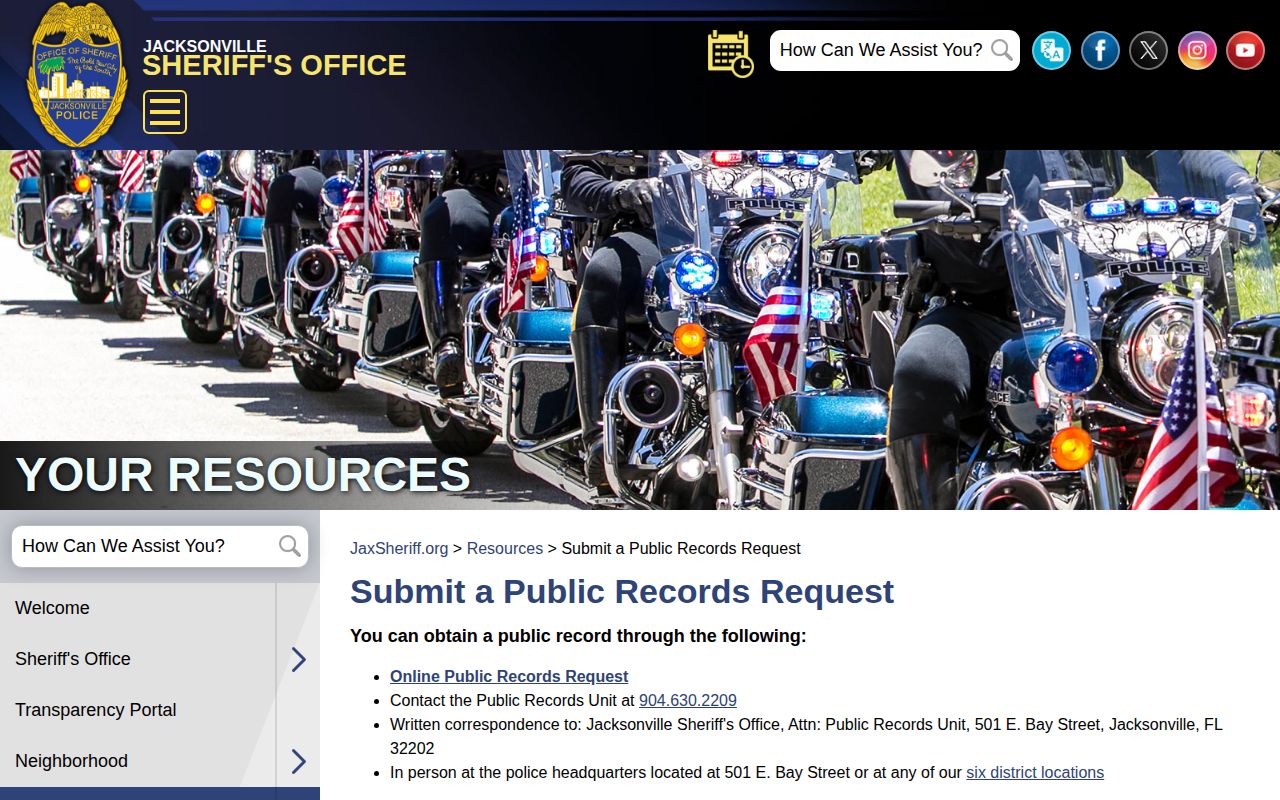
This route also lets the custodian apply any exemption, redaction, sealing, or expunction rule to the exact record.
Duval Mugshots Beyond Official Records
A local news story, official press release, or social post may retain an image after the person is released. Publication is selective. It does not form a countywide photo index and may not reflect later case events. Match the image to a booking identifier, then check the current JSO and court records before describing the custody or case status.
Third-party archives can copy, crop, mislabel, or retain a photograph after an official source changes access. They may also merge people with similar names or fail to add a later release or disposition. No commercial mugshot publisher or data-broker link is provided or endorsed. If such an image is encountered, treat it as a lead only. The official booking number and source record take priority.
An arrest photograph documents one past event. It does not prove guilt, conviction, present custody, supervision, or present dangerousness. Dignity and accuracy require current status to be stated separately from the existence of an old image.
Florida Released Mugshot Removal Law
Florida Statutes section 901.43 governs covered commercial booking-photo publishers. A covered publisher may not solicit or accept payment to remove a booking photograph. The photographed person or legal representative can send a written request by registered mail with proof of identity and details that identify the image. When the statute applies, removal must occur without charge within 10 calendar days, and the publisher may not republish the photo.
The law is not a universal erasure order for all government and news archives. Its scope and exceptions matter. An official JSO record follows public-record, exemption, retention, and court-access rules. A news organization may have a distinct editorial archive. Do not pay an unverified service or assume a commercial-removal rule forces an official agency to erase a lawful record.
Duval Mugshots After Expungement
Sealing and expunction can restrict ordinary access to arrest and court records, but eligibility and effect are fact-specific. FDLE's certificate-of-eligibility process comes before a petition to the court. Florida sections 943.0585 and 943.059 govern court-ordered expunction and sealing. A dismissed charge alone does not guarantee that an image or case qualifies.
Duval supplies a local seal and expunge forms page that connects applicants with the FDLE certificate process. Applicable court supervision must end before eligibility under the cited provisions. FDLE's automatic state-history sealing also does not automatically seal each local agency or court record. Needed public arrest reports, dispositions, and orders should be obtained before access changes.
If CORE or JSO no longer shows a record, respect the restriction. Do not try to reconstruct it through commercial copies. An absent result may also reflect juvenile confidentiality, spelling, interface limits, or a different jurisdiction. The correct statement is that no public confirmation was found in that channel.
Note: Direct a JSO image question to the records custodian and a court-file access question to the Duval Clerk.
FDC Photos for Duval Releases
FDC offender details commonly include a state photograph, but that image belongs to the Florida prison record. It may have been created after a Duval jail booking or during a separate state custody event. Use it only when the JSO or court history shows a state sentence or the person has a DC number. A person who bonded out of Goode on a county matter may have no FDC record.
FDC Inmate Release Information separates state release records from the current prison population. A released detail can show a release date, custody history, offenses, county case numbers, and a photograph. A future Current Release Date remains a projection. The historical release entry, not the photograph, establishes that state incarceration ended.
After opening an FDC result, compare the DC number, full name, birth information, aliases, county, offense history, and court case number. A photograph can assist with identity, yet it cannot cure a mismatch in those fields. The state database also excludes ordinary county-jail inmates and people supervised only through a local county system. If the Duval record shows no state commitment, return to JSO rather than forcing a match in FDC. When a state photo and a Duval booking photo differ, describe each by its source and custody episode instead of choosing one as the person's permanent image.
The public FDC example below is included only to show the type of state release fields and photo area that may appear.
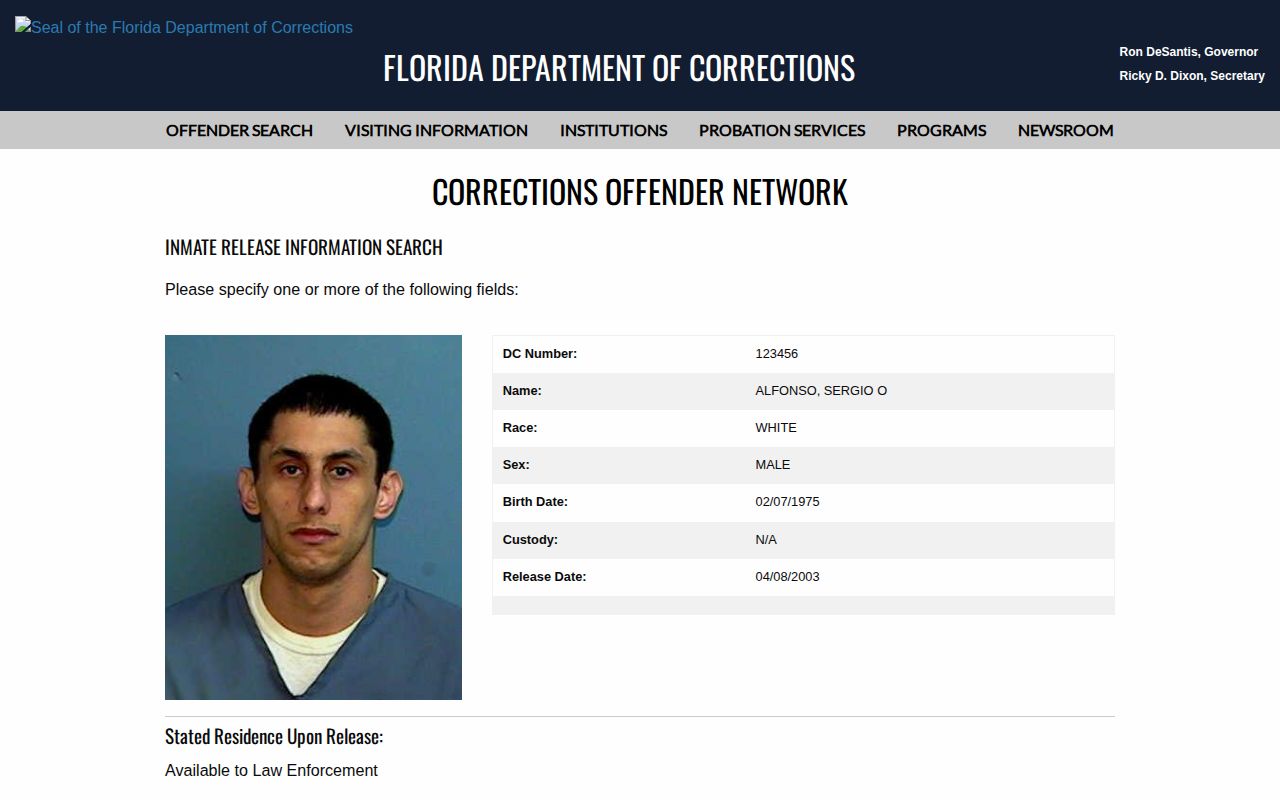
Always distinguish that state offender image from the original Duval County booking photograph.