
Duval Parole and Probation Compared
Parole follows release from prison under authority of the Florida Commission on Offender Review, or FCOR, for the cases within its jurisdiction. It is most often relevant to older parole-eligible Florida sentences. Probation is imposed by a court, often instead of prison or after a custody term. Florida Department of Corrections officers supervise felony probationers, parolees, people on conditional release, and other state community-supervision categories.
Duval County also has local routes. Professional Probation Services handles misdemeanor probation, while the Jacksonville Sheriff's Office Electronic Monitoring Unit deals with people specifically ordered onto monitoring. A person released pretrial is not automatically on probation or parole. The court docket and the correct supervision search establish what, if anything, continues.
| Record type | Who orders it | Where to verify |
|---|---|---|
| Parole | FCOR under Florida law | FDC supervised population plus the FCOR order |
| Felony probation | Criminal court | FDC supervised population and Duval CORE |
| Misdemeanor probation | Duval court | Duval CORE and Professional Probation Services |
| Electronic monitoring | Court or release authority | Order and JSO Electronic Monitoring Unit |
- Parole
- Conditional community release from a parole-eligible prison sentence.
- Probation
- Court-ordered supervision in the community.
- Discharge
- The formal end of a supervision term.
- Absconder
- A supervised person who is unavailable and has a violation warrant.
Verify Duval Post-Release Supervision
The FDC Supervised Population search is the first state channel. Search by DC number when known because it identifies the state record more precisely than a name. A name search still requires a match on birth date, county, offense, photograph, and other identifiers. The result may identify the current status and supervising circuit or office. It does not cover every Duval misdemeanor case.
- Classify the case as state felony supervision, local misdemeanor probation, or electronic monitoring.
- Search FDC by DC number or exact name for state supervision.
- Read the status exactly. Active and Active Suspense do not mean the same thing.
- Match the Duval court case in CORE to the probation, community-control, or termination order.
- Contact the named office with the DC number and exact field when the records conflict.
FDC describes Active as current community supervision. Active Suspense means direct supervision is paused because the person is temporarily unavailable, often due to confinement, though monitoring remains in place. Neither status should be inferred from a jail record alone. The Duval County released inmate search paths can confirm the separate custody exit before supervision is checked.
The official search screen can be reviewed at its FDC source.
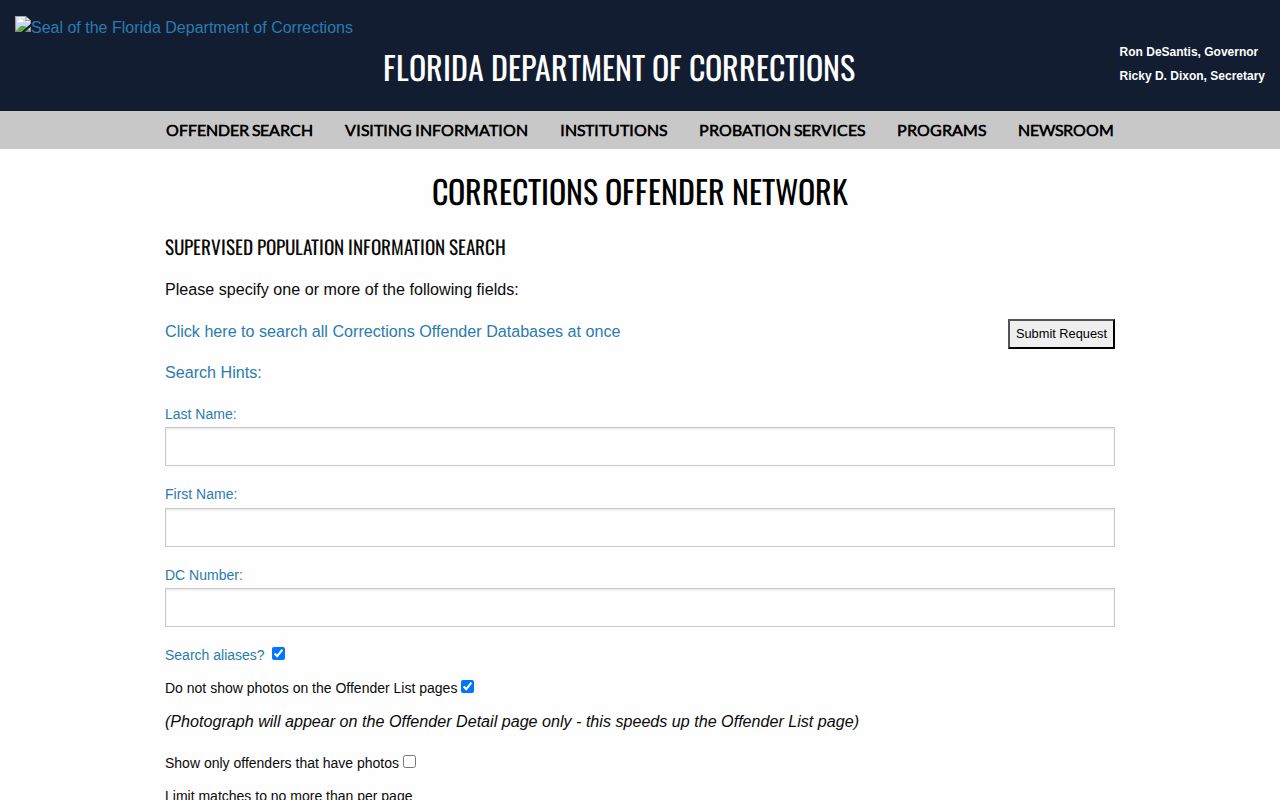
The form separates community supervision from current prison custody and inmate release records.
Duval State Supervision Office
Duval County belongs to FDC Region 2, Circuit 4. The Jacksonville Circuit Office serves Clay, Duval, and Nassau Counties. Its reported circuit total was 6,789 supervised people as of February 13, 2026. That figure is dated and covers the full circuit, not Duval alone.
FDC Jacksonville Circuit Office921 N. Davis Street, Building B, Suite 235
Jacksonville, FL 32209
904-924-6847
Fax: 904-301-3679
jacksonville.cir@fdc.myflorida.com
Use this office for a state supervision record that names Circuit 4. FDC's central community-supervision data contact is 850-717-3444 or co-supervision@fdc.myflorida.com. A specific probation officer may be unable to disclose all case-management details, but the public database and court order can still establish the supervision category.
Note: A Duval County address does not prove that the Jacksonville office currently owns the case; use the office shown on the live record.
Duval Absconder and Warrant Records
Florida keeps a separate Absconder/Fugitive Search. An absconder status means FDC reports that a person is unavailable for supervision and that a violation warrant has issued. It does not show a successful discharge. It also does not prove current physical custody in John E. Goode or any other jail.
JSO's wanted-person portal is a different system. A wanted entry can concern local process without proving FDC parole or probation. Conversely, an FDC absconder result can exist before a current Duval jail booking appears. Record the agency, warrant language, DC number, and update date instead of merging the two.
Supervision conditions come from the court judgment, Commission order, or other controlling release document. A public database status does not replace those terms. When a violation is alleged, the warrant or later order shows the legal action; the original release date still records the earlier custody exit.
The FDC Absconder Unit can be reached at 850-717-3475 on weekdays from 8 a.m. to 5 p.m. Tips go to law enforcement. Personal confrontation is unsafe. Florida Statutes sections 947.22 and 947.24 distinguish arrest authority for a parole violation from eventual discharge.
How Duval Supervision Ends
Supervision ends through a formal termination, discharge, court order, or Commission action. A prison release date does not prove that step. For state supervision, check FDC's supervised-population result and any termination date, then read the controlling court or FCOR order. FDC refreshes most supervision data weekly, while termination dates and office-location changes are updated nightly.
For a Duval probation case, CORE may show an order terminating probation, satisfaction, or a later violation event. A docket label is an index entry. Open the signed document or request it when exact terms matter. For parole and Commission programs, the final FCOR action is stronger evidence than a meeting agenda.
Duval Parole Hearing Records
The FCOR voting schedule and dynamic agenda show planned Commission matters. At the research date, ordinary voting meetings were set for Wednesday mornings with Thursday follow-up sessions, but the live calendar controls. Agenda fields can include a name, DC number, Duval County, offense, case number, category, and the kind of action under review.
An agenda is not a ruling. No simple public person-level final-results database was verified. Request the Commission action or final order through FCOR public records, then compare it with FDC release and supervision data. Interview eligibility under section 947.16 also is not release approval. Florida parole mainly applies to legacy parole-eligible sentences, while many modern prison exits follow sentence and gain-time rules.
Duval Reentry After Supervision Starts
The Jacksonville Re-Entry Center is a local navigation and service hub, not a detention facility and not proof of supervision. JSO's fiscal 2023-24 report says JREC provided 8,962 bus passes and paid for 260 Florida IDs, driver licenses, or birth certificates. Counselors also worked with FDC and visited Goode, Montgomery, and CTC. Those are dated program totals, not benefits promised to each person.
JREC can help a returning person deal with practical needs while the supervising authority remains FDC, FCOR, a court, or a local provider. Keep service help separate from legal status. An appointment, bus pass, or visit to JREC does not alter probation or parole conditions.
Duval Release Property and ID
Post-release paperwork can be hard to resolve without identification. JSO limits public-lobby property pickup at Goode and Montgomery to money and keys. Montgomery's property room is 904-630-8869. JREC's documented identity work offers a local route for IDs and birth certificates, but it does not replace the release record or supervision order.
For an immediate custody-status error, call JSO Jail/Inmate Information at 904-630-5760. A documented correction or release-record request belongs with the JSO Public Records Unit. These channels address different issues from a probation officer, so give each office the identifier and field it controls.