
Duval Juvenile Detention Releases
Duval Regional Juvenile Detention Center is a secure Florida Department of Juvenile Justice facility. Youth are held while juvenile court matters move through adjudication, disposition, or placement. Adjudication is the court's decision on whether the allegation was proved. Disposition is the juvenile case stage that sets the next legal outcome. Because the center serves this court process, leaving the building can mean release to an approved parent or guardian, movement under a court order, or transfer to another authorized placement.
Those paths must not be combined into a public released-inmate list. A transfer ends the stay at this center but may continue DJJ custody or another court-ordered placement. A community return may also include juvenile probation or other conditions that are not open to general public inspection. The order and information available to the youth's authorized representative determine what happened. No public adult record should be used to guess the destination.
Confirm a Duval Juvenile Release
Confirmation begins with the person's lawful relationship to the youth and the court case. Parents, legal guardians, counsel, and other authorized representatives can use official contacts tied to that case. A member of the public should not expect DJJ or the juvenile court to disclose protected custody details. Confidentiality is a legal boundary, not evidence that an agency lacks a record.
- Identify the youth's case and the responsible juvenile court or counsel. Use only information already lawfully available to the authorized person.
- Contact counsel or the court for the order that controls release, detention, or placement. A court event explains authority but may not state the physical processing time.
- An approved parent or legal guardian may contact the center or assigned DJJ professional for instructions that may lawfully be shared.
- Ask whether the youth returned to an approved custodian or moved to another placement. Do not call every departure a community release.
- Follow any identification, pickup, court, or supervision instructions given through the official case channel.
The Duval County release-record overview covers adult county, state, and federal paths. It does not replace this juvenile process. JSO historical results are suited to adult county bookings. FDC release results concern state prison. Neither should be searched merely because the youth center is located in Jacksonville.
Note: No result in an adult jail search does not confirm release from secure juvenile detention or identify a receiving placement.
Duval Juvenile Release Record Access
Youth custody and court records are substantially restricted. An adult release record may disclose a booking number, charges, and an exit date through a public sheriff portal. The same public access should not be assumed for a juvenile. The authorized route depends on the type of record: DJJ for information within its lawful control, counsel for case guidance, and the juvenile court for an order or case record available to that requester.
An access-restricted or absent court result does not show that the youth is still detained. It also does not prove release or that no case exists. Juvenile confidentiality, the requester's access level, spelling, or a different circuit can explain the gap. Respect the restriction. Do not try to reconstruct a protected record from adult systems, copied databases, social posts, or unrelated people with a similar name.
| Question | Correct channel | What it can establish |
|---|---|---|
| What did the court order? | Counsel or juvenile court | The legal authority for detention, release, supervision, or placement, subject to access rules. |
| What instructions apply now? | Assigned DJJ professional or facility | Directions that may be given to an approved parent, guardian, or representative. |
| Did the youth enter adult JSO custody? | JSO only when an adult booking is independently known | An adult custody episode, not the juvenile center's release record. |
| Where did the youth go? | Authorized case channel | Whether the next step was approved custody, supervision, or another placement. |
This split prevents two common errors. One is treating confidentiality as proof of release. The other is treating a move between placements as freedom from all custody. Use the narrow source that controls each question.
Duval Juvenile Release Contact
The official DJJ facility page supplies the current facility contact and visitation information. A call does not override confidentiality. Staff may require proof that the caller is a parent, legal guardian, counsel, or otherwise authorized before discussing a youth or giving case-specific instructions.
1241 E 8th Street
Jacksonville, FL 32206-4099
Phone: 904-944-8240
Fax: 904-359-6640
Operator: Florida Department of Juvenile Justice
The official DJJ facility profile is the source for the address, phone, service area, program description, and visit schedule.
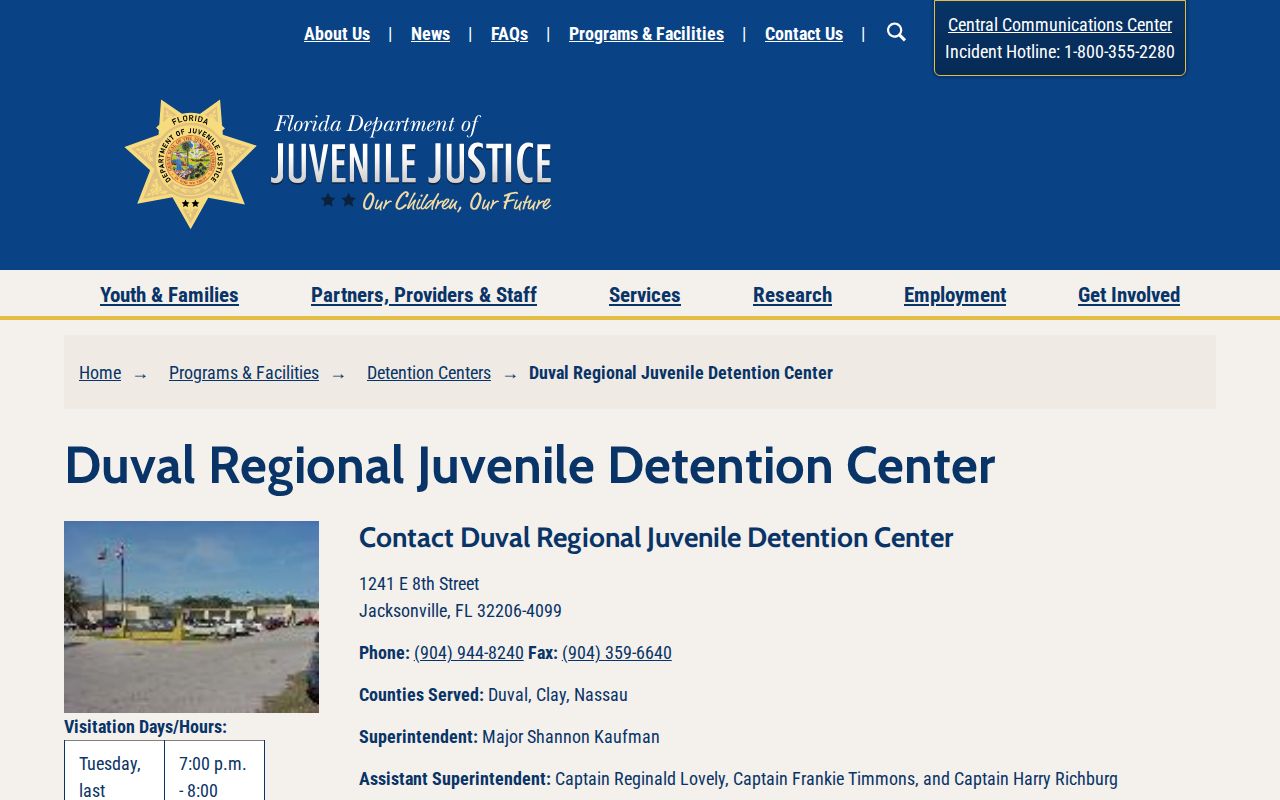
The image documents the official facility source. It does not show or publish any youth custody record.
Duval Juvenile Custody Records
DJJ describes the center as a hardware-secure detention facility. Hardware secure means physical security features and controlled movement are used to hold youth under court authority. The center serves youth from Duval, Clay, and Nassau Counties. It is not one of the three adult JSO corrections institutions, even though it appears in the broader county facility map.
Youth may be detained pending adjudication, disposition, or placement in a commitment facility. DJJ says the center provides supervision in a safe, secure, and humane setting. Services include education, health care, mental health, and substance-abuse care. A typical day includes meals, hygiene, school, structured physical and educational activity, and court appearances as scheduled.
These facts explain why the adult released-inmate model does not fit. A juvenile stay is tied to a protected court and service process. The public capacity figure describes the facility. It does not reveal occupancy, identify a youth, or show who left on a given day.
Duval Juvenile Release Versus Transfer
The words release and transfer must remain separate. Release can mean the court and DJJ authorized a youth to leave secure detention for an approved custodian, often with a case still pending or conditions still in force. Transfer means the youth moved to another detention, residential, commitment, medical, or court-authorized setting. The center's custody episode may end in both situations, but only one necessarily returns the youth to a home setting.
- Secure detention
- Short-term, physically secure custody while the juvenile court process continues.
- Disposition
- The stage when the juvenile court determines the case outcome and next legal requirements.
- Commitment placement
- A court-ordered DJJ placement that can follow disposition and continue custody outside this center.
- Community supervision
- Court or DJJ requirements that can continue after physical detention ends.
A parent or guardian should follow the exact pickup and reporting directions received through the case channel. No public source reviewed supplies a blanket release hour, exit location, or rule that applies to each youth. Do not import adult jail assumptions into the juvenile process.
Duval Juvenile Custody Visits
Visitation rules illustrate the center's controlled access. DJJ lists parents, grandparents, and legal guardians as approved visitors. Another person may visit only if the court orders it or the superintendent or designee specifically approves it. Legal counsel, probation, law enforcement, clergy, and other professionals may visit as needed, subject to sign-in and contraband controls. All visitors must have photo identification.
The published schedule divides family visits by last name. Names A through M are listed for Tuesday evening and Saturday afternoon. Names N through Z are listed for Thursday evening and Sunday afternoon. DJJ warns that holiday hours may change. Confirm the live schedule with the facility before traveling, and do not treat a visit cancellation or schedule change as evidence of release.
This controlled process supports accurate routing. An approved family member can ask staff for current instructions within the limits of lawful disclosure. An unrelated caller should not expect the facility to confirm whether a named youth is detained or released.
Jacksonville Detention Facility Planning
Jacksonville's City Council studied the future of the downtown jail and other JSO primary facilities after finding that the existing sites exceeded their useful life. The committee considered relocation, costs, health care, and related operating issues. That work concerns local facility planning and must not be turned into a claim that a new jail opened or that a release point changed.
The distinction is even more important here. Duval Regional Juvenile Detention Center is operated by Florida DJJ, not JSO. A city discussion about the downtown adult jail does not prove a change to this youth facility's address, court process, or release route. The current Jacksonville committee record documents the planning topic, while the DJJ profile remains the controlling source for the juvenile center.
Note: Facility planning is not a custody record and cannot confirm that any youth was released, transferred, or moved.